


Dental FAQ: Answers to Common Patient Questions
In brief
Plain answers to the questions patients ask most, grouped by topic, with links to the full guides.
Our dental FAQ groups common patient questions by topic, from veneers and implants to emergencies and insurance. Short answers come first, then the details that help you decide. Choose a topic below. Or read the most-asked questions on this page, each linked to a deeper guide.
Every answer here was written for this office and checked against published sources, which are listed at the bottom of each page. None of it replaces an exam: what suits your teeth depends on what a dentist sees. For the services themselves, see our services. If your question isn't covered, call (818) 658-9285 and ask.
Browse by topic: Veneers · Dental implants · Cosmetic dentistry · All-on-X and dentures · Teeth whitening · Invisalign and orthodontics · General dentistry · TMJ and teeth grinding · Sleep apnea and snoring · Emergency dentist
- Veneers FAQ46 questions
- Dental implants FAQ33 questions
- Cosmetic dentistry FAQ26 questions
- All-on-X and dentures FAQ20 questions
- Teeth whitening FAQ23 questions
- Insurance and financing FAQ12 questions
- Invisalign and orthodontics FAQ21 questions
- General dentistry FAQ22 questions
- TMJ and teeth grinding FAQ19 questions
- Sleep apnea and snoring FAQ
- Emergency dentist FAQ20 questions
Key takeaways
- Each topic page answers its questions in short, direct paragraphs, with links to the full guides.
- Answers give the trade-offs as well as the benefits, so you can compare options honestly.
- Nothing here replaces an exam; your own plan depends on your teeth and health.
2 questions
Veneers questions
Veneers are thin coverings bonded to the front of teeth to change how they look. These are the two questions asked most.
What are veneers?
Veneers are thin, custom-made shells bonded to the front of teeth to change their color, shape, size or length. Porcelain veneers are made in a dental lab, and composite veneers are sculpted from resin on the tooth. They change how front teeth look but don't move teeth or replace missing ones.
Most people get veneers on the teeth that show when they smile. Porcelain resists stains and wear well, and it usually needs a thin layer of enamel removed, so the change can't be undone. Composite takes less enamel and is easier to repair, but it stains and wears sooner. Veneers suit healthy teeth: decay or gum disease is treated first, and heavy grinding or a deep overbite can make them a poor fit.
How long do veneers last?
Porcelain veneers are strong and long-lasting, while composite veneers are not as wear-resistant and usually need attention sooner. A veneer may chip, crack, wear down or loosen over time, requiring your dentist to re-bond, repair or replace it. Grinding, biting hard objects and daily cleaning all affect how long yours last.
A 2023 review found "The overall pooled survival rate of the randomized controlled trials was 88%" for composite veneers, "with the mean follow-up time ranging from 24 to 97 months." A veneer that chips or comes loose can often be repaired or re-bonded rather than replaced. Regular checkups help either type last. Ask what your own plan expects for upkeep.
2 questions
Dental implant questions
Dental implants replace missing teeth from the root up. These are the two questions asked most.
What are dental implants?
Dental implants are small posts that a dentist places in the jawbone to replace the roots of missing teeth. Once the bone grows around them, they anchor a crown, bridge or denture. They can replace one tooth, several or a full arch, without relying on neighboring teeth for support.
The ADA describes implants as posts surgically placed in the upper or lower jaw that act as a sturdy anchor for replacement teeth. Healing takes up to several months while the bone fuses with the implant, and a temporary tooth often fills the gap in the meantime. Most healthy adults can be considered: health matters more than age, and smoking or uncontrolled diabetes can slow healing.
How long do dental implants last?
In a 2019 review, the summary estimate for long-term survival at the implant level was high. The crown on top usually wears sooner and may need replacing. Smoking, infection of the gum around the implant and heavy grinding all shorten an implant's life.
The same review's sensitivity meta-analysis estimated somewhat lower survival, and older age (65 years or more) was a significant predictor of lower survival. The FDA notes that regularly cleaning the implant and the teeth around it is very important for long-term success, so daily brushing, cleaning between teeth and regular checkups matter as much as the surgery.
2 questions
Cosmetic dentistry questions
Cosmetic dentistry focuses on how teeth and smiles look, from whitening and bonding to veneers. These are the two questions asked most.
What is cosmetic dentistry?
Cosmetic dentistry is dental care aimed mainly at improving how your teeth and smile look. Common treatments include whitening, bonding, veneers and gum contouring. It's built on healthy teeth and gums, so decay or gum disease is treated first. Insurance usually doesn't cover purely cosmetic work.
The U.S. National Library of Medicine's index files cosmetic dentistry under dental esthetics, which it describes as improving the appearance as well as the function of the teeth, mouth and face. Good cosmetic work keeps function in view: a change that looks right but strains your bite won't hold up well. Some treatments can't be undone, so it makes sense to start with options that remove little or no tooth.
What does a cosmetic dentist do?
A cosmetic dentist changes how teeth look, using treatments such as whitening, bonding, veneers, crowns and gum contouring. Cosmetic dentistry is not one of the ADA-recognized dental specialties. Many cosmetic dentists are general dentists who focus on this work. Planning starts with your oral health and bite.
Day to day, that means examining your teeth and gums, planning changes with photos, scans or a mock-up, and doing the treatment. Dr. Faraz Farahnik, DDS (Dr. Raz) is a general dentist whose practice focuses on cosmetic and restorative dentistry. The ADEA's competencies for general dentists include restorative work that is esthetic. It's fair to ask any dentist how often they do the treatment you want and how the result will be previewed.
2 questions
All-on-X and denture questions
Full-arch implants and dentures replace most or all of the teeth in a jaw. These are two of the questions asked most.
What are implant dentures?
Implant dentures are full or partial dentures held in place by dental implants instead of resting only on the gums. Some snap onto the implants and come out for cleaning. Others are fixed bridges that only a dentist can remove. Both need enough jawbone, or a bone graft first.
Because they're anchored to implants, implant-supported dentures are more stable than traditional dentures. The trade-offs are surgery, a few months of healing while the implants fuse with bone, and more involved daily cleaning for fixed versions, including under the bridge. Your dentist can explain both types.
What are All-on-4® dental implants?
All-on-4® is a way of replacing a full arch of teeth with a fixed bridge on four implants. The back implants are often tilted to make use of the available bone. The bridge doesn't come out at home; your dentist removes it for maintenance.
A consensus statement says "The main indication of All-On-4 standard care is an atrophic maxilla or mandible, with or without remnant hopeless tooth." One review found "implant number (4 versus 6) did not affect implant or prosthesis survival."
See all All-on-X and dentures questions
All-on-4® is a registered trademark of Nobel Biocare Services AG. Veneers & Co. Dental Group is not affiliated with or endorsed by Nobel Biocare.
2 questions
Teeth whitening questions
Teeth whitening lightens natural teeth with peroxide bleach, in the office or at home. These are two of the questions asked most.
What is teeth whitening?
Teeth whitening lightens the color of natural teeth, usually with a peroxide bleach. It can be done in a dental office, at home with trays from your dentist, or with store products such as strips. It doesn't change crowns, veneers or fillings, and results fade over time.
Whitening toothpaste is different: ADA-Accepted whitening toothpastes remove surface stains but don't change the tooth's color. Stains from food, drink and tobacco usually respond well. Stains from inside the tooth, such as after an injury or from some medicines, respond less well. Temporary sensitivity is a known side effect of every form of bleaching. An exam first can find the cause of the discoloration.
Do whitening strips work?
Yes, peroxide whitening strips can lighten natural teeth when used as directed. They use a weaker bleach than dentist-supplied gels, so they usually take longer to reach a similar shade. Look for strips with the ADA Seal of Acceptance. They won't lighten crowns, veneers or fillings.
The ADA notes most whitening strips rely mainly on peroxide. Overuse of whiteners can also damage the tooth enamel or gums, so follow the package timing. If sensitivity starts, you can pause and try again later. Deep or uneven stains may need a dentist's help instead, because their cause can differ.
2 questions
Invisalign and orthodontics questions
Clear aligners are clear, thin, plastic-like trays custom-formed to fit your mouth that move the teeth. Invisalign® is one brand of clear aligner. These are the two questions asked most.
What is Invisalign®?
Clear aligners are sets of clear, thin, plastic-like trays, custom-formed to fit your mouth, that move the teeth a fraction of a millimeter at a time. They must be removed when you eat or drink and when brushing and flossing. Invisalign® is one brand of clear aligner.
The AAO describes aligners as worn at least 22 hours a day, with each one moving teeth a tiny amount. Clear aligners are not right for every bite, so an exam decides whether they suit you. Retainers follow treatment to hold the result in place.
Are braces or Invisalign® better?
A 2025 review found no significant differences in treatment quality in non-extraction cases, while braces gave better results in extraction cases. Aligners are removable and less visible, but they only work when worn. So neither is better for everyone; your bite and habits decide.
A 2020 review found that patients treated with Invisalign appear to feel lower levels of pain than those with fixed braces during the first few days of treatment, and after that differences were not noted. Aligners need steady wear, and a review found "Compliance with removable orthodontic appliances and adjuncts is suboptimal, and patients routinely overestimate duration of wear." Both need retainers afterward. Our Invisalign vs braces comparison goes into more detail.
2 questions
General dentistry questions
A general dentist is the primary oral health care provider for all age groups. These are two of the questions asked most.
What is a general dentist?
A general dentist is the main dental care provider for patients of all ages. General dentists diagnose and treat most dental problems, coordinate your overall oral care and refer you to other dental or medical providers when needed. Many also provide cosmetic and restorative treatment.
The American Dental Education Association describes the general dentist as the primary oral health care provider for all age groups. It also expects general dentists to work within their competence and refer to colleagues when indicated. Its competencies include restorative care that preserves or replaces tooth structure, and replacing missing teeth. Dr. Farahnik is a general dentist whose practice focuses on cosmetic and restorative dentistry.
What are dental crowns?
A dental crown is a cap that covers the visible part of a tooth to restore its shape and strength. Crowns protect weak or broken teeth, hold large fillings or bridges in place and cover dental implants. They can be made of porcelain, ceramic, metal or a combination.
The ADA notes a crown can strengthen a tooth with a large filling when there isn't enough tooth left to hold the filling. It can also protect a weak tooth from breaking or restore one that's already broken. Getting a crown usually means shaping the tooth so the cap fits over it. Ask which material suits the tooth's position and your bite.
2 questions
TMJ and teeth grinding questions
TMDs cause pain and dysfunction in the jaw joint and muscles, and experts recommend conservative treatments first. These are the two questions asked most.
What is TMJ disorder?
TMJ disorder, or TMD, is a group of conditions causing pain or trouble in the jaw joint and jaw muscles. Common signs are jaw pain, stiffness, limited opening and painful clicking. For many people, symptoms ease over time without any treatment.
The NIDCR uses TMJ for the joint itself and TMD for the disorders. In most cases the exact cause isn't clear, and a mix of factors, including stress and how someone perceives pain, may play a part. Because evidence for many treatments is limited, experts recommend conservative, reversible care first and avoiding treatments that change the bite for good. A dental exam checks the joints and muscles.
What is teeth grinding?
Teeth grinding, called bruxism, is clenching or grinding your teeth, often during sleep and often without knowing it. It can chip or wear teeth and cause jaw soreness or dull headaches. A dentist often spots the signs first.
The ADA notes many people also clench during the day, especially when tense or worried. Stress is a common link, but sleep disorders, teeth that don't line up and missing or crooked teeth can play a part too. Because grinding can have other causes, your dentist or doctor may help look for the root cause.
2 questions
Emergency dentist questions
Urgent dental care relieves severe pain and lowers the risk of infection. These are the two questions asked most.
Are there emergency dentists?
Yes. The dentist is an appropriate person to see for most causes of toothaches, according to MedlinePlus. Dr. Farahnik is a general dentist whose practice focuses on cosmetic and restorative dentistry. A call or text is the way to start.
MedlinePlus notes the dentist is an appropriate person to see for most causes of toothaches. The ADA lists severe tooth pain, an abscess, a broken tooth and a knocked-out tooth among problems dental offices treat as urgent. The Encino walk-through of what counts as a dental emergency covers pain, abscesses, broken teeth and similar urgent problems. If you're unsure whether a problem is urgent, describe it when you call or text.
Can I see an emergency dentist?
Yes. If you have a dental problem that can't wait, call or text the office and give as much detail as possible about your condition. For a knocked-out adult tooth, keep it moist at all times and get to your dentist's office right away. If you have a medical emergency, call 911.
The ADA's advice is to call your dentist and give as much detail as possible about your condition. Our number is (818) 658-9285. Mention when the problem started, where it hurts and anything that broke off. Treatment takes place at our office in Los Angeles; we don't offer house calls. Bring your insurance card if you have one, and a list of your medicines.
Practice
Practice questions
Insurance, financing and languages at our Encino office. For smile makeovers, see the cosmetic dentistry questions.
Do you accept PPO plans?
Yes, all PPO plans. We check your benefits before treatment. Every step is handled in-house at 16260 Ventura Blvd, Suite 730, Encino, all under one roof. If you have a question before or after treatment, you can call or text (818) 658-9285 at any hour.
What languages are spoken?
English, Spanish, Farsi and Arabic, plus translation software for other languages.
Is financing available?
Yes: Cherry first, then CareCredit, plus Sunbit and in-house financing. Our team checks your PPO benefits before treatment, and Cherry, then CareCredit, can spread the rest over time, subject to credit approval.
Does anyone at your office speak Farsi?
Yes. Dr. Farahnik is fluent in Farsi, so you can discuss your goals, your plan and aftercare in Farsi if you prefer.
Have a question that isn't here? Call (818) 658-9285 and we'll answer it.
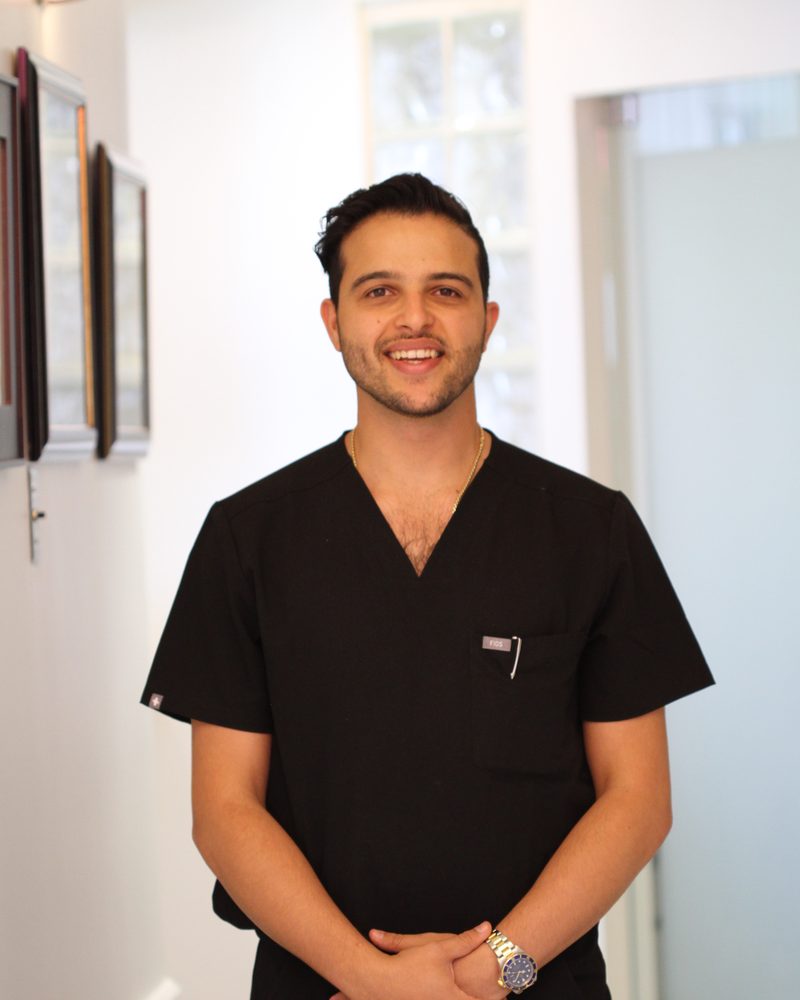
The dentist
About your dentist
Faraz Farahnik, DDS is a general dentist whose practice focuses on cosmetic and restorative dentistry.
- Education
- UCLA, with honors · DDS, USC, 2018
- Practicing
- Practicing dentist since 2018
- Languages
- English · Farsi
Begin
Start with a phone consultation
Call or text (818) 658-9285 with your questions first; a written plan still waits for an exam in the Encino office.